

"Just Be You" Trials of a Writer

Author’s Note:
I originally wrote this piece for a theater show back in Middletown, CT which featured one act plays by local playwrights. I have updated its content for today. It was originally called “To Be Me.” After the show, the playwrights stayed for a Q&A, and when it was time for me to speak about my show, I said that getting called sir was a common occurrence for me. “In fact,” I said, “it happened tonight in the restroom before the show started.” The audience laughed, getting the not-so-subtle irony. A man who dressed in female drag stood up and, through tears, thanked me for writing this piece, saying how necessary it was to get this message out. After the Q&A, I gave him a hug and thanked him for what he said, and we stayed in contact for many years after. That was one of the most positive experiences that has stuck with me through all the years.
Without further ado. . .
Just Be You
by Tara McMillen
Once upon a time, I hated to be called ma'am. “I’m not old enough to be a ma’am! I’m a miss!” Back then, getting called sir or mister was part of everyday life, and did not upset me. Now I’m happy if they say ‘ma’am' because it means they know I’m a woman, or at least have guessed right. When did this start to become a problem?

That is not a question I can answer right now, but it is connected to the issue I face as I (for real this time) pursue a fiction writing career. To be me or not to be me, that is the real question. Turn your back on your true identity, and what happens to your soul? To your self-esteem? That’s like saying “I hate myself.” But I love myself! I want to stand up to the world and say, “I’m a queer dyke and it has nothing to do with me being a writer.” However, if it were that easy, it wouldn’t be so hard for LGBTQ writers and actors to get recognition. We can’t all be Ellen DeGeneres and globally accepted as the leader of all lesbians!
I assume you, wonderful reader, are familiar with the term “anti-gay activist”. I guess in a world of Ying and Yang, if we have gay activists we must have anti-gay activists or risk a paradox and the world blowing up. This tug of war is not a new issue. Anti-gay activists have always fought to take our rights away. And sometimes they win. And it hurts. It’s hard to watch people who don’t know you fighting so hard to make sure you feel like a second-class citizen. But I don’t need to watch the news or keep up minute-to-minute monitoring of social media for the latest assault on my human rights. I know that as a queer lesbian and aspiring novelist, I have a choice straight people don’t have to think about. Do I start my career on the outside of the closet or hide inside it?
The problem is that if I start out loud and proud, I run the risk of getting pigeonholed. I want to be taken serious; to write whatever I want to write and be recognized on the merit of my writing … Not “Oh, it was good for a gay play,” as, in the past, I’ve heard people say. I know there are books, TV, and films that have LGBTQ characters. I’m even reading a book that broaches the subject of gender non-conforming, using they/them pronouns in a simple, inclusive way. We are definitely in a new hopeful era, however, there’s a man in the White House who not only encourages but rewards hate speech and hate crimes, which hastens the rolling back of our civil and human rights. For this reason, I still fear writing outside of that closet.
To give context to my fears, I’d like to share a few experiences. Getting called sir has been something I’ve had to deal with as far back as I can remember. Once when I was 8 years old, I had short hair. I was walking home from school along the same road I always took, when a man, working on the roof of his house, called out to me: “Hey little boy!” I think he wanted me to help him with something, but I don’t remember; all I heard was him mistaking me for a boy. I called back: “I’m not a boy, I’m a girl!” And kept walking. Probably a good thing too, because looking back on that, he could easily have been a pedophile looking for his next victim.
Later, in my twenties, I had hair down to my ass:

Okay, obviously that's not me in the photo, but you get the point. Long ass hair. One night, I went to the store before going out clubbing. I was decked out in femme form fitting jeans, spaghetti strap top, and femme boots. The young male clerk noticed me from the corner of his eye and called me sir. I said, “Really?” He looked me full in the face. His eyes opened wide and he stammered, “I mean ma’am.”
Then one day, about 11 years ago, after dreaming of it for years, I cut all that hair off to a “boy” short length. It was the most freeing experience. I’m so used to the short hair now, but back then, I wasn’t prepared to be cruised by gay boys—not for nothing, but I could do pretty damn good as a gay boy. I get mistaken as a man by others too. I remember a time when I was walking toward the exit of the women’s bathroom and an elderly woman came in, saw me, backed up, and looked at the symbol on the door to make sure she was in the right bathroom.
I’ve definitely forgotten more stories than I can remember, but each experience has imprinted itself in me, whether I remember it or not. I understand that getting called sir is not inherently life-threatening, but when you look like a sir but are not, there are those who won’t let their homophobia go. One night, many years ago, a friend was leaving a popular gay bar when several young men surrounded her. My friend was a large butch woman. You took one look at her and knew she was a dyke. These men started to harass her . . . she may have fought back. I don’t know. I wasn’t there. These men brutally beat her and left her with severe injuries. She was terrified to leave her home for months after the attack. All I could think was, “Where was I? Where were her other friends? How can this happen outside of a busy bar and no one intervenes?” The last time I saw her, she was a shell of the person she’d once been. This particular gay bashing took place over ten years ago, but this same type of gay bashing still happens today.
For these reasons (and many more), I have been scared of outing myself. But this isn’t a rant about ma’am vs. miss, or long hair vs. short. It’s not a rant about hate crimes, getting called sir, or being challenged in the ladies room. My point is that people take one look at me, and they know I’m gay. So am I fooling myself that people won’t stereotype me? I’ll simplify it for you; if you want to tear me down, do it if my writing sucks, but don’t deny me success because I date women. I want the same chance at success that everyone else gets. I want that chance for all gay, bi, lez, trans, binary/nonbinary, non-gender conforming/gender conforming, genderqueer, and anyone else who falls outside the accepted “norm”!
To be you or not to be you? With all the dangers of being yourself when you are different from the supposed majority, it can be easy to justify hiding; it’s called self-preservation. But, despite the dangers, there are excellent reasons to being out, loud, and proud.
It pisses off anti-gay activists.
Just being you fosters acceptance.
It shows people who are suffering from the same/similar problems that they are not alone.
People sense you are hiding something and since they can’t read minds, they don’t know WHAT you are hiding, and make up their own minds about what you are hiding, without ever asking you what you are hiding. This fosters suspicion, bad feelings, resentment, etc.
And it’s worth repeating, being yourself fosters acceptance, as well as your self-esteem.
I think the benefits far outweigh the negatives, so just be you.

Screw Self-Doubt
I am a subtle person. I’m not flashy, not perky. I’m soft-spoken and prefer listening to talking. I despise small talk and quickly run out of things to talk about in social settings. How much of this is because I am rattled with self-doubt? I can also be a walking contradiction; for example, I live in the PNW where coffee and seafood are a couple of main staples of life, yet I don’t like seafood, and only on rare occasions drink coffee. Where is the line between a person’s personality and the self-doubting lies that plague our everyday choices?
I am here to make a statement on doubt. I am not a straight arrow; my arrow weaves in and out, turning left, right, up, down, and around the current societal topics of popular interest. All of my blogs are about sharing a part of myself; this is why I share my writer’s diary. Once upon a time, I was victimized, so much so that the experience set me on a self-destructive path of low self-esteem, my future choices and reactions ruled by self-doubt. Being vulnerable in front of people terrifies me to my core, so even writing this statement is difficult.
This blog post is not designed to tell you how to get rid of self-doubt or how to know when you are suffering from it. Chances are, if you are alive, you have self-doubt, so there’s no need to wonder. And you don’t “get rid” of self-doubt, you learn how to live with it and to not let it dictate your daily choices. Therefore, this blog post is not about that; it is purely about my experience with it and I hope that by sharing my own trials and tribulations with the process, my story will resonate with someone, and then the healing process can begin. Recognizing this thing called doubt that we all have in common, is paramount to moving forward.
That in mind, I’m going to make a bold statement: women and female-bodied persons are raised to doubt, men and male-bodied persons are not. Gay men are sexually aggressive while women (gay or straight), will look but not approach. I’m not going to attempt to talk about the differences between binary and non-binary in this post; I mean only to include my own personal experience as a cis-gendered woman. I am also broadly generalizing, for point-making’s sake, but the standard of how boys are raised versus girls seems to prove true more often than not. It also goes a long way to show the differences between men and women, regardless of sexual orientation.
For example, last week, for Halloween, I drew a realistic beard on my face, planning to go out to Lesbian Karaoke. Before I went out, I thought it’d be a good idea to write a piece about the self-doubt I was experiencing about wearing the beard to karaoke.

The regular broken record had begun playing in my mind: Should I? Shouldn’t I? Should I? Shouldn’t I? I wound up running out of time, and so I ignored the broken record to the best of my ability, “painted” the beard on my face, and went out to karaoke. If you’ve seen my Facebook post, then you know what happened. For those who did not see it, in a nutshell, I was treated like a star. I got stared at by every gay man in the joint, until I sang and they realized I’m a woman; I got hit on relentlessly, and had people walking up to engage me in conversation. I’m a regular at this bar, and I have never been treated like this; for the first time, I was visible. It was a profound experience for me because of how invisible and forgettable I have felt for most of my life. It was a profound experience because I have never been visible in this bar, yet paint a beard on my face, pass as a man, and suddenly they couldn’t hit on me fast enough: even the gay women. I came home that night and HAD to write about it before I could sleep, proving to myself, for the millionth time, that I am a writer above all else.
How much of feeling invisible is locked arm in arm with self-doubt? Can I overcome my powers of invisibility by ignoring the self-doubt? As an over-thinker, doubt creeps in to make me wonder if I’ve said something wrong if a person takes “too long” to answer. Doubt makes me think I can't do something I've already done dozens of times. Doubt causes me to not talk to women I find attractive, thinking they won’t find me interesting. Or I wait too long to talk to them, and they leave or move on before I can make a move. I want to experiment with different clothes styles, but doubt makes me think that people will not accept me, and so I continue dressing the same way I always have, too scared to try something new. Ultimately, doubt keeps me from being who I really am.
For some contrast, let me share my experience from several years ago when I went as a man for Halloween. I painted my face, put on a suit and hat, and went out. I passed back then too, even making one acquaintance think I was his evil ex-boyfriend, until I spoke and my feminine voice dashed the illusion. I got cruised by gay men and straight women, but not to the level of aggressiveness that I did this most recent time. No one approached me or hit on me, or even challenged me in the women’s rest room.
The only difference between that time and this time is slightly better makeup and a dash of confidence that did not exist for me back then. Did I mention that I’ve been working on saying no, taking back my power, no longer freely giving it away to anyone who asks? I’ve been working on that and I have noticed differences in my own happiness. I feel like I’m taking care of myself. I feel strong. I feel. . . dare I say it. . .happy!
So, is it possible that when I went to karaoke as a man last week, that this little bit of confidence I have built as a woman was enough to propel me when dressed as a man to someone that everyone wanted to talk to? My conclusion, you don’t need a lot of confidence to be taken serious when you are a man or male-bodied person. Women and female-bodied persons need to be damn near invincible, grow bullet proof skin, and never give in if we want to be taken serious. Is it any wonder we are so accustomed to self-doubt that we don’t even recognize the self-hating, destructive thought patterns?
I hope I have not depressed anyone too much, because I understand what a difficult subject this is. For too long, I have blamed others for my own short-comings, but no one forced me to listen to the doubt that has played constantly in my mind. That’s all on me. That said, I do not believe the subject of doubt is a comfortable conversation for anyone. Personally, I refuse to submit to these negative thoughts any longer, and so I look deeper within myself to see what is going on with me. Sometimes this actually helps.
I will leave off here with a question for you: how has self-doubt affected your life, and what’s another way to experience those self-doubting moments?
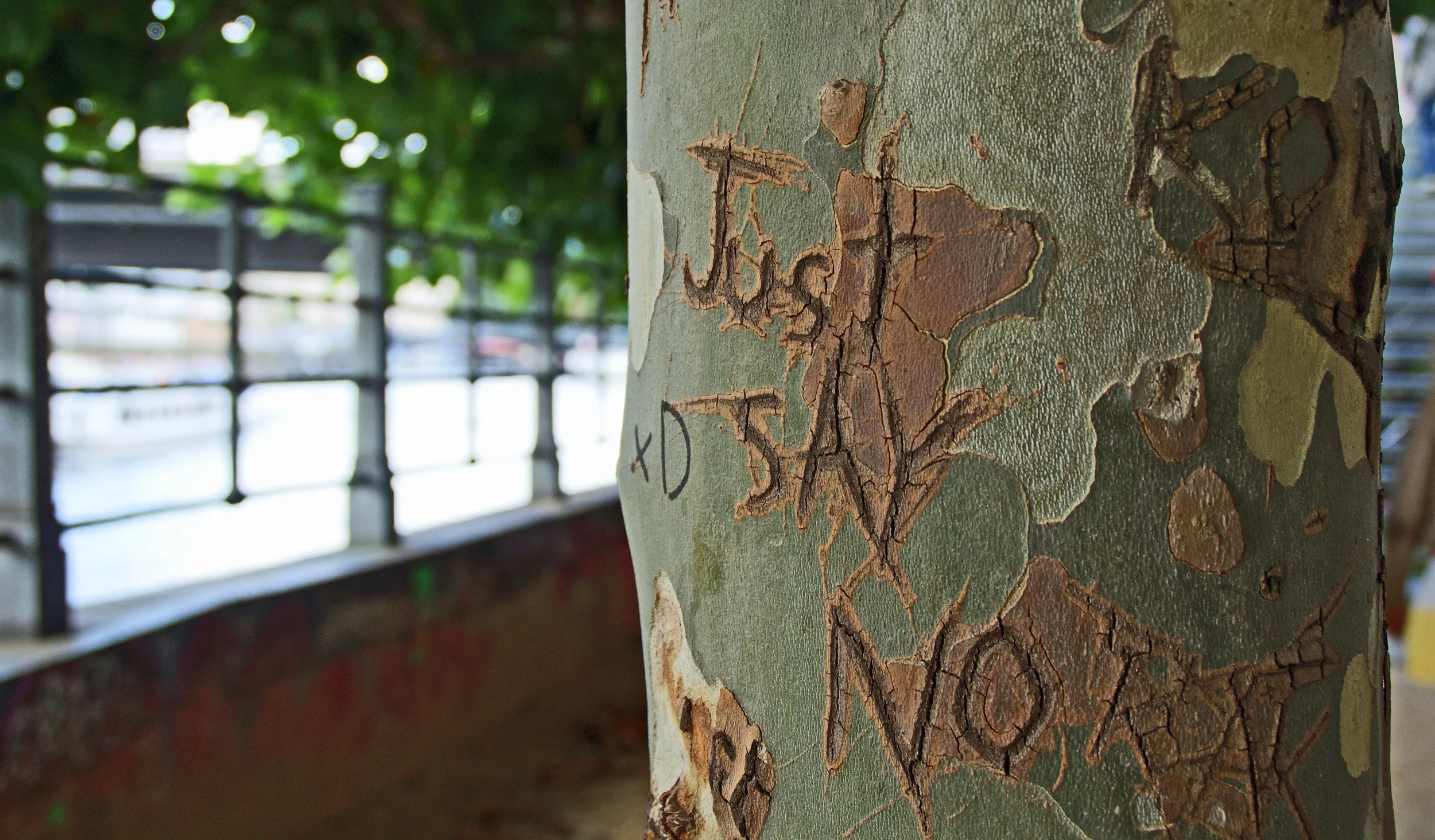
Here's Why Saying 'No' in This Rape-Culture Society Might be Harder Than You Think

I took my first self-defense class today (12/1/18) and was surprised by how much talking there was. Talking about our feelings, and about fear, and anger. Talking about a lot of stuff that has flown my mind’s coup, but suffice to say that it was a lot of talking for the first two hours. In this time, I realized/remembered my problems with saying no to people: friends, family, co-workers, strangers. Sadly enough, yes, I even have a hard time saying no to strangers. I do it, but the feelings that come up are that I feel bad for how my saying no will possibly hurt their feelings. I avoid the glaring reality that I am putting their needs and feelings above my own; I am disregarding my own right to say what goes on regarding me and my body. This was a huge A-HA moment, but also an eye-opening reminder that I had figured this out years ago, and promptly forgot. I decided that “saying no” is worth revisiting, unpacking, and strengthening, and thusly, my blog finally took shape. Confirming this fact for me happened in the workshop today. We did an exercise in which we asked a partner if we could touch their hand. The first time, the answer was supposed to be ‘no’. The second time was up to the partner. Then we swapped, and it was my turn to say ‘no’ first, and then decide yes or no for the second time asked. Without even thinking about it, I said “No” the first time. And then for the second time, I said “yes” even though I wanted to say no. I was worried about my partner’s feelings and the fact she had said no when I’d asked her, and so I wanted to add variety, and thusly said ‘yes.’ As I later shared my experience with the class, I realized several things. First, I said no because I had been told to. I didn’t even question it. Second, I was so concerned about hurting her feelings that the second time she asked if she could touch my hand, I said yes so that she wouldn’t think I was rejecting her. Thirdly, I was additionally so concerned about my perception of adding variety, that I did not consider that she might not want to touch my hand. After all, she had answered ‘no’ when I’d asked her.
I feel that “saying no” deserves a spotlight, and so I am creating this space to look into this subject, to give it air to breath, to give it the attention it deserves.